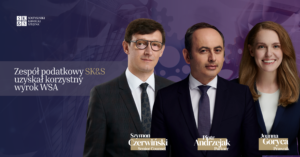
The SK&S tax team obtained a favorable judgment of the WSA
Jesteśmy kancelarią, którą tworzą ludzie o ogromnej pasji, wiedzy i doświadczeniu. Nasz zespół stale się powiększa.


The SK&S tax team, consisting of Szymon Czerwiński, Piotr Andrzejak and Joanna Goryca, obtained for one of its clients a favorable judgment of the WSA (case no. III SA/Wa 2483/22) confirming that no income was earned by a partner in connection with the division of a company. The verdict referred to the assessment of the tax consequences of a split already after the Polish Order came into force. Thus, it concerned situations where the tax neutrality of demergers or mergers was disturbed due to the fact that a shareholder of the company being divided had obtained shares as part of earlier restructuring activities.
The WSA in Warsaw overturned the KIS Director's interpretation and indicated that the effects of the split should have been assessed solely through the prism of the provision excluding the generation of income due to the existence of two organized parts of an enterprise in the company being split. Since the KIS Director found the applicant's position with regard to the existence of two OCPs to be correct, there was no basis, in the Court's opinion, for additional creation of income based on the restructuring criteria under the Polish-landlord regulations.
The judgment obtained is not final, but it is an important ruling in the context of the interpretation of the criticized provisions of the Polish-Load, which introduced negative consequences for many restructuring activities. The emerging jurisprudential practice may help reverse the consequences of these ill-considered regulations and make restructurings in capital groups more efficient.